
One bad hosting decision.
That’s all it takes to slow your sites, frustrate your clients, and quietly damage your reputation.
And here’s the uncomfortable truth: most WordPress users don’t realize their hosting stack is the bottleneck until performance drops, costs spike, or scaling becomes painful.
If you’re searching for the best Cloudways alternatives in 2026, chances are you’ve already hit that ceiling.
Whether it’s:
- Rising costs as you scale
- Limited server-level control
- Inconsistent support
- Or performance constraints under load
You’re not alone – and more importantly, you have better options now.
After personally testing FlyWP, RunCloud, Ploi, ServerAvatar, GridPane, and SpinupWP, today I’m breaking down an honest, hands-on comparison to help you find the best Cloudways alternative for your needs in 2026.
TL;DR:
Cloudways is still a solid managed hosting option, but rising costs, limited server control, and the DigitalOcean acquisition have pushed many developers and agencies to look elsewhere in 2026.
The best Cloudways alternatives right now are:
- FlyWP – Best overall: full infrastructure control, Docker-powered environments, transparent usage-based pricing starting at $5/month, plus an all-in-one managed hosting option starting at $7/month
- RunCloud – Best lightweight option for experienced developers at $9/month
- Ploi – Best for Git-heavy workflows and clean deployment automation at $8/month
- ServerAvatar – Best for beginners moving off shared hosting, self-managed plan at $69/month
- GridPane – Best for high-traffic enterprise WordPress sites, paid plans from $19/month
- SpinupWP – Best purpose-built WordPress control panel at $12/month
If you want the best balance of control, automation, and transparent pricing in 2026, FlyWP is the strongest Cloudways alternative for developers and agencies of any size.
How I Chose These Cloudways Alternatives
Choosing which platforms to include wasn’t random. I focused on tools that actually give you meaningful control over your server environment – not just a prettier dashboard over shared hosting. To make this list, each platform had to support major cloud providers, offer real useful features, and be actively maintained with a growing user base.
I also evaluated transparent pricing (no hidden fees), quality of documentation and support, and whether the platform can realistically serve both solo developers and agencies at scale.
What Should a Good Server Management Platform Have?
Before jumping into comparisons, it helps to know what you’re actually looking for. A solid server management platform should cover these essentials:
- Server Provisioning & Automation: Deploy new servers and sites in minutes with fully automated configurations.
- Performance Optimization: Built-in caching, PHP tuning, and CDN support to keep your sites fast under any traffic load.
- Backups & Security: Automated daily backups, SSL certificates, firewall protection, and malware scanning as standard features.
- Scalability & Resource Control: Easily scale server resources as your sites and traffic grow without switching platforms.
- Developer-Friendly Tools: SSH access, Git integration, WP-CLI, staging environments, and cron job management for full workflow control.
- Team Collaboration & Multi-User Access: Role-based permissions and multi-user management for agencies and growing teams.
- Multiple Cloud Provider Support: Works with DigitalOcean, AWS, Google Cloud, Vultr, and Linode for maximum infrastructure flexibility.
- Multisite & Multilingual Support: Full compatibility for managing multiple WordPress sites and multilingual setups from one dashboard.
- Transparent Pricing: Clear, upfront pricing with no hidden fees or surprise billing at any plan level.
- Reliable Support & Documentation: Responsive support team and thorough knowledge base to help you troubleshoot and grow confidently.
Comparing the Best Cloudways Alternatives for 2026
To make things easier, here’s a side-by-side comparison of the top Cloudways alternatives based on pricing, key differences, and ideal use cases:
| PlatForm | Key Difference | Best For | Starting price |
|---|---|---|---|
| FlyWP | Best balance of control, automation, and transparent pricing | Developers and agencies who want full control, automation, and transparent pricing at scale | $5/month (self-managed) $7/month (managed hosting) |
| RunCloud | Lightweight, no-nonsense platform for experienced developers | Independent developers and freelancers who want lightweight, affordable server management | $9/month |
| Ploi | Cleanest Git integration for streamlined developer workflows | Developers who rely heavily on Git-based deployments and clean workflow automation | $8/month |
| ServerAvatar | Most beginner-friendly cloud server management platform | Beginners and small businesses stepping up from shared hosting for the first time | $69/month (self-managed) |
| GridPane | Most performance-focused platform for enterprise environments | Agencies and developers managing multiple high-traffic and enterprise WordPress sites | $19/month |
| SpinupWP | Most WordPress-focused server control panel built by WordPress experts | WordPress developers and agencies who want a purpose-built panel designed specifically around WordPress best practices | $12/month |
| Cloudways | Best managed hosting with flexible cloud provider choices | Businesses and teams that want managed cloud hosting with flexible provider options | $14/month |
Cloudways Alternatives Reviewed: Pricing, Features & Platform Breakdown (2026)
1. FlyWP
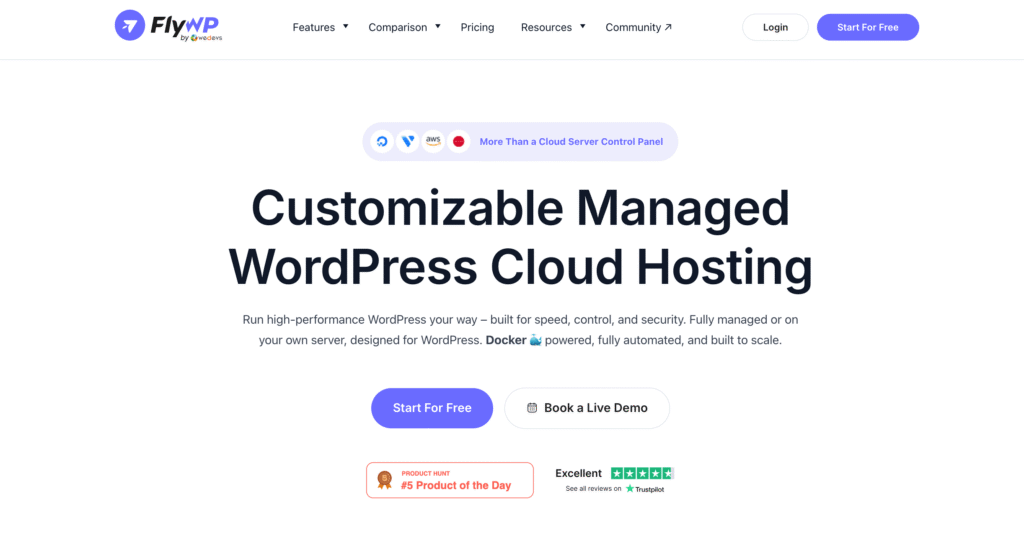
FlyWP is a managed WordPress hosting platform that combines powerful WordPress cloud server management with a modern, intuitive WordPress server control panel – all built specifically for WordPress.
It gives you full cloud infrastructure control and with the newly introduced customizable managed hosting, even teams who want a simpler, hands-off setup can now get started without juggling separate provider billing.
What Makes FlyWP Stand Out
- Full Cloud Infrastructure Control
- One-Click WordPress Deployment & Staging
- Automated Backups, Caching & Security
- Developer-Friendly Git, SSH & WP-CLI
- Docker-Powered Containerization for Isolated WordPress Environments
- Multi-Site & Multilingual Support
- Team & Role-Based Management
- Two pricing paths: Self-Managed (connect your own cloud) and All-in-One Managed Hosting (single billing, no separate provider account needed)
- Works with All Major Cloud Providers including DigitalOcean, Vultr & Akamai
Pros
- Best balance of control and usability for WordPress-focused teams
- Scales easily for agencies and multi-site setups
- Strong performance and security out of the box
- Transparent usage-based pricing, pay only for what you use
- All-in-one managed hosting with no separate server and panel billing
- Team collaboration built-in from day one
- Free forever plan to get started with no commitment
Cons
- Requires basic server knowledge for initial setup
- May feel overwhelming for complete beginners
Best For
- WordPress agencies managing multiple client sites
- Freelance developers managing sites for multiple clients
- Developer teams that need role-based access and collaboration tools
- Growing businesses that have outgrown shared hosting
- Tech-savvy WordPress site owners who want server-level control
- Agencies that need white label server management for clients
- Developers who work across multiple cloud providers like DigitalOcean, Vultr, and Akamai
- Teams or businesses looking for all-in-one managed WordPress hosting without juggling separate provider billing
- Anyone who wants premium server management without enterprise pricing
Pricing
FlyWP offers a free forever plan to get started. For self-managed hosting, paid plans start from $5/month per server (1–3 servers) and managed hosting plans start from $7/month.
All paid plans include unlimited sites and everything FlyWP has to offer, with optional add-ons available separately. You can also explore the pricing page.
2. RunCloud

RunCloud is a PHP server management platform. It handles Laravel, CakePHP, Symfony, Node.js, and other PHP frameworks equally well – WordPress is one of many supported applications.
It connects to all the major cloud providers and gives you a clean dashboard with necessary features.
What Makes RunCloud Stand Out
- Broad PHP stack support: WordPress, Laravel, Node.js, and more
- Connects to DigitalOcean, AWS, Google Cloud, Vultr & Linode
- One-Click WordPress Deployment with Optimized Caching
- Git Deployment, SSH & WP-CLI
- Server Monitoring & Real-Time Performance Alerts
- Automatic SSL & Firewall Protection
- Multi-User & Role-Based Access
- Lightweight & Intuitive Dashboard
Pros
- Fast and reliable server provisioning
- Developer-friendly workflow automation
- Strong server monitoring and real-time alerts
- Flexible multi-server management
- Affordable entry-level pricing
Cons
- Not suitable for beginners
- No fully managed WordPress features
- Some advanced configurations require manual setup
Best For
- PHP developers managing a mix of WordPress, Laravel, and other apps
- Technical freelancers comfortable in the command line
- Small development teams managing multiple servers across different stacks
- Developers who want server provisioning without framework-specific bloat
Pricing
Plans start at $9/month per server, one of the most affordable server management platforms on this list.
3. Ploi
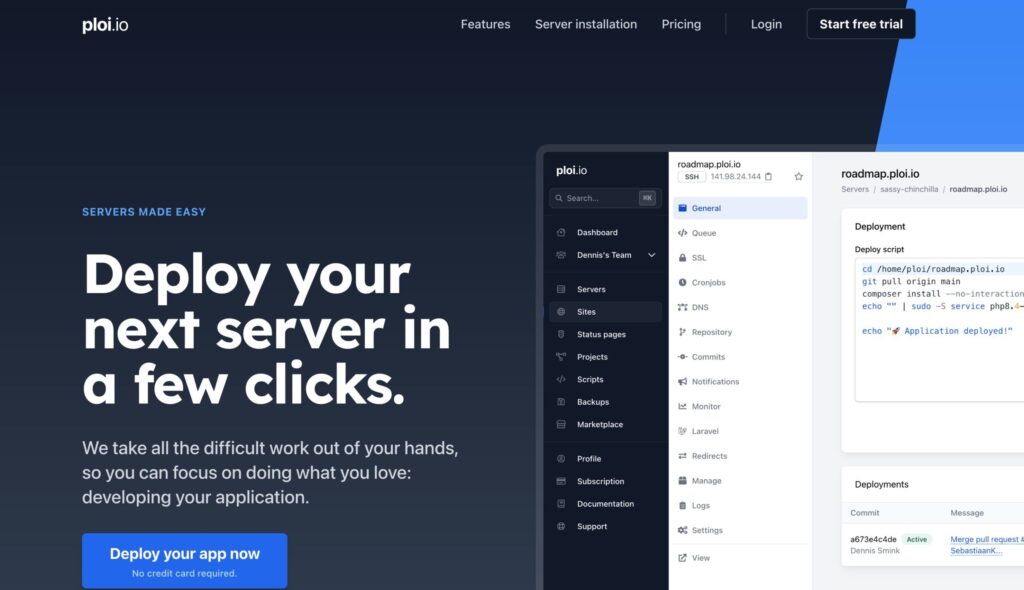
Ploi occupies a sweet spot between simplicity and developer power. It’s a PHP and Laravel-first server management platform that also supports WordPress through a one-click installer. The team openly markets it as “built by Laravel developers, for Laravel developers.”
If RunCloud feels slightly too bare for your needs, Ploi adds just enough structure without becoming bloated.
What Makes Ploi Stand Out
- Laravel-optimized with zero-downtime deployments and Artisan command support
- Connects to DigitalOcean, AWS, Google Cloud & Vultr
- One-Click WordPress Deployment with SSL & PHP Optimization
- Smooth Git Integration for Streamlined Deployments
- SSH & WP-CLI Access
- Automated SSL & Server Security
- Multi-User & Role-Based Access
Pros
- Clean and efficient server management experience
- Excellent Git integration
- Quick WordPress provisioning
- Secure with automated SSL and firewall
- Flexible multi-server support
Cons
- Steeper learning curve for beginners
- Smaller community and documentation
- Limited fully managed features
Best For
- PHP developers who work with both Laravel and WordPress daily
- Developers who deploy from Git repositories as their primary workflow
- Freelancers who want a lightweight alternative with clean automation
- Small agencies managing mixed PHP project portfolios
Pricing
Plans start at $8/month per server with higher plans adding team collaboration, staging, and Git deployment.
4. ServerAvatar
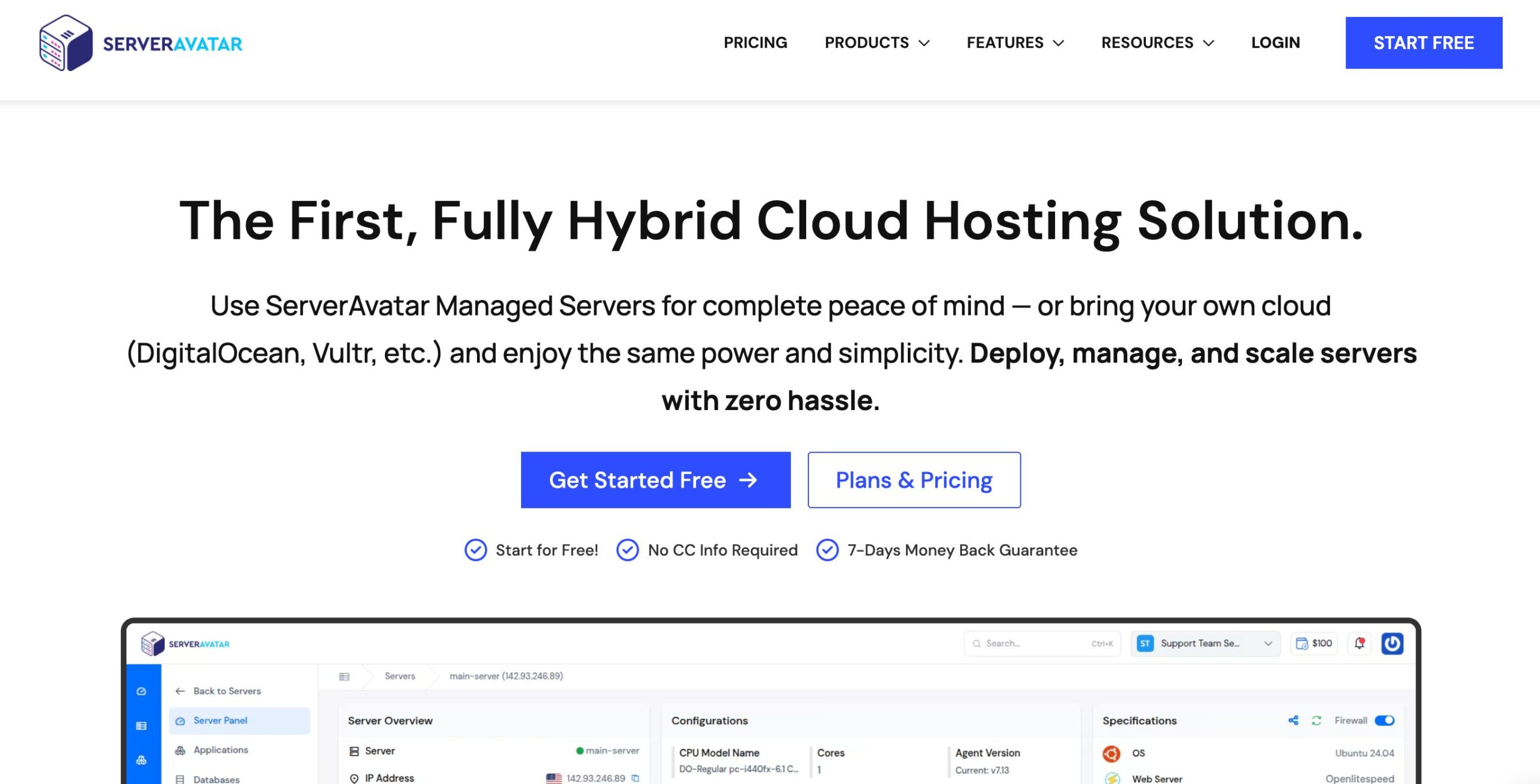
ServerAvatar is the platform you recommend to someone who wants cloud server control but isn’t ready for the complexity of RunCloud or GridPane. It supports WordPress, PHP, Laravel, Node.js, Mautic, n8n, and more, making it one of the more versatile platforms on this list.
The interface is genuinely beginner-friendly, clean, well-organized, and easy to navigate even without deep server experience.
What Makes ServerAvatar Stand Out
- Multi-stack support: WordPress, PHP, Laravel, Node.js, Mautic, n8n and more
- Automated Server Optimization (Nginx, PHP, MySQL)
- One-Click WordPress Deployment with Caching & Security
- Free SSL & Firewall Protection
- Beginner-Friendly Interface
- Uptime & Performance Monitoring
- Multi-User Support
- Both self-managed (bring your own server) and fully managed server options
- Free-forever plan available (ServerAvatar Lite)
Pros
- Easiest server management platform to get started with
- Supports the widest range of application stacks on this list
- Built-in security and optimization from day one
- Affordable pricing for small teams
- Multi-site and team support included
Cons
- Limited advanced developer features
- Smaller community for troubleshooting
- Not ideal for high-traffic or complex setups
Best For
- Small business owners managing their own WordPress site alongside other PHP or Node.js apps
- Bloggers and content creators stepping up from shared hosting
- Non-technical WordPress users who want more control than shared hosting offers
- Developers working across multiple tech stacks who want one panel
- Freelancers who manage diverse project types for different clients
Pricing
Plans startat $69/month per server including automated backups, caching, SSL, and security
5. GridPane

If you manage multiple high-traffic WordPress sites for enterprise clients or large agencies, GridPane is built for exactly that. It is WordPress-only by design and by choice.
It is the most performance-focused server management platform on this list optimized at every level from Nginx and PHP-FPM configuration to automated malware scanning and firewall management.
What Makes GridPane Stand Out
- Server-Level Optimization (Nginx, PHP-FPM, Caching)
- Multi-Site Management with Staging & Cloning
- Full Automation for Updates, SSL, Backups & Monitoring
- Git, SSH, WP-CLI & Cron Job Management
- Advanced Security (Firewall & Malware Scanning)
- Multi-User Access for Agency Teams
Pros
- Powerful automation reduces manual server management
- Multi-site and multi-server support
- Advanced security built-in
- Ideal for high-traffic environments
Cons
- WordPress only – cannot run Laravel, Node.js, or other non-WordPress apps without voiding support
- Higher cost than most server management platforms
- Steep learning curve for beginners
- Not plug-and-play for non-technical users
Best For
- Large WordPress agencies managing enterprise client sites
- Developers running high-traffic WordPress sites with demanding performance requirements
- Agencies where downtime or slow load times directly impact client revenue
- Enterprise WordPress operators who need maximum automation and security
- Developers who need deep server-level optimization including Nginx and PHP-FPM configuration
Pricing
Plans start at $19/month, best suited for agencies managing multiple high-traffic WordPress sites. GridPane also offers a free Core plan.
6. SpinupWP

SpinupWP is the platform you recommend to someone who lives and breathes WordPress and wants a server control panel built specifically around WordPress best practices from the ground up.
It was created by the team behind Delicious Brains, a group with deep WordPress roots, and that expertise shows in every feature, workflow, and design decision the platform makes.
What Makes SpinupWP Stand Out
- Purpose-Built WordPress Server Control Panel (PHP apps also supported on LEMP stack)
- Git Deployment with Full Workflow Automation
- Redis Object Caching and Full Page Caching Built In
- Cloudflare Integration for DNS and Security Management
- Team and Client Access with Role-Based Permissions
- Automatic Database and File Backups to Multiple Destinations
Pros
- Built exclusively for WordPress with deep platform knowledge baked in
- Clean, intuitive interface that feels familiar to WordPress developers
- Excellent Git-based deployment workflow for modern development teams
- Strong community and documentation backed by a trusted WordPress team
- Reliable performance optimizations designed specifically for WordPress
Cons
- Not ideal for non-WordPress applications or mixed hosting environments
- Fewer server provider options compared to broader platforms like RunCloud
- Can feel limiting for developers who need deep server-level customization
- Higher price point compared to entry-level alternatives like ServerAvatar
Best For
- WordPress developers who want a panel built by people who understand WordPress deeply
- Agencies managing multiple client WordPress sites with team access and permissions
- Developers who rely on Git-based deployments and modern WordPress workflows
- Freelancers who want a reliable, WordPress-optimized server environment without complexity
Pricing
SpinupWP offers two paid plans starting at $12/month for the Essentials plan and $19/month for the Advanced plan, both covering 1 server with unlimited sites and a 7-day free trial with no credit card required.
Editor’s Note : What Really Stands Out Among Cloudways Alternatives
After testing several Cloudways alternatives, a clear pattern emerges – most platforms either prioritize control or simplicity, but rarely both.
RunCloud and Ploi are great for developers who want lightweight control, while GridPane excels in high-performance, enterprise environments. ServerAvatar, on the other hand, is ideal for beginners looking for an easier entry point.
However, when it comes to balancing control, scalability, and ease of use, some platforms feel more complete than others. In that context, FlyWP stands out as a well-rounded option, especially for teams managing multiple WordPress sites across different cloud providers with a need for both flexibility and streamlined workflows.
You can book a 1:1 demo with FlyWP to explore the platform and see if it truly fits your needs and workflow.
FAQ
What is the best Cloudways alternative in 2026?
FlyWP is the strongest all-around alternative for WordPress developers and agencies, offering full infrastructure control, Docker-powered environments, and transparent pricing.
Are Cloudways alternatives cheaper?
Yes, many Cloudways alternatives offer more flexible and often lower pricing. Platforms like FlyWP and RunCloud use usage-based or per-server pricing models, which can be more cost-efficient for developers and agencies.
What is a server management platform?
A server management platform is a tool that helps you set up, configure, monitor, and manage your web servers without needing deep technical command-line expertise. It simplifies tasks like deploying websites, managing databases, handling SSL certificates, and monitoring server performance.
Is a server management platform the same as a hosting provider?
No. A hosting provider gives you the physical server infrastructure, while a server management platform helps you manage it. Cloudways bundles both, which is why it costs more. Platforms like FlyWP, RunCloud, and GridPane are management layers you connect to your own cloud account.
Do I need coding knowledge to use a server management platform?
It depends on the platform. ServerAvatar and FlyWP are the most beginner-friendly on this list. GridPane and RunCloud assume more technical confidence. None of them require command-line expertise for everyday tasks, but basic server knowledge helps when troubleshooting.
Can I use multiple cloud providers with these platforms?
Yes, most server management platforms support multiple cloud providers. FlyWP, RunCloud, Ploi, and GridPane all allow you to connect servers from providers like DigitalOcean, AWS, Vultr, Akamai, Linode, and more, giving you full flexibility over your infrastructure.
Can I migrate my existing websites to a new server management platform?
Yes, most server management platforms offer migration tools or step-by-step guides to help you move your existing websites. Some platforms even offer free or assisted migration services to make the transition as smooth as possible.
Which Cloudways alternative is best for WordPress developers?
For WordPress-only workflows, FlyWP, GridPane, and SpinupWP are the strongest choices, each offering deep WordPress-specific optimization, staging, and WP-CLI support. If you also manage Laravel or other PHP apps alongside WordPress, RunCloud or Ploi are more practical fits.
Why are people leaving Cloudways in 2026?
Since DigitalOcean acquired Cloudways in 2022, many users have reported rising costs, reduced support responsiveness, and tighter server-level control. Developers managing multiple sites at scale increasingly find that self-managed platforms offer better value and more flexibility.
Final verdict : Best Cloudways Alternative in 2026
Choosing the right Cloudways alternative depends on your needs, technical expertise, and project scale.
RunCloud and Ploi offer lightweight, affordable server management with far more control than Cloudways ever allows. GridPane dominates for high-traffic enterprise environments. SpinupWP wins for WordPress-first developers. ServerAvatar is the friendliest starting point for beginners.
All of them offer better transparency, more control, and fairer pricing than Cloudways.
But FlyWP stands above them all, combining full infrastructure control, agency-ready collaboration, transparent pricing, and effortless WordPress management into one platform that every other alternative wishes it could be.